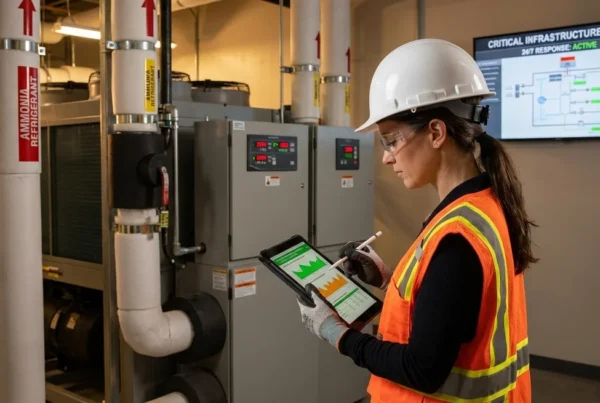
When a data center’s cooling system fails, the clock starts immediately. Servers begin thermal throttling within minutes. Without intervention, automatic shutdowns follow. And with every passing moment, the costs mount—often exceeding $9,000 per minute for large facilities and reaching $300,000 or more per hour for enterprise operations.
This isn’t a hypothetical scenario. It’s a reality that data center operators across North America face with increasing frequency as aging infrastructure struggles to meet the demands of modern computing workloads. The result is a surge in demand for specialized cooling service providers who can deliver preventive maintenance, emergency response, and the technical expertise to keep mission-critical facilities running.
The global HVAC services market is projected to reach nearly $98 billion by 2030, with data centers representing the fastest-growing end-user segment at an 8.4% compound annual growth rate. Within the data center cooling market specifically, maintenance and support services are expected to dominate market share through the forecast period, reflecting operators’ recognition that sophisticated cooling infrastructure requires equally sophisticated ongoing support.
The Maintenance Imperative: Why Reactive Approaches Are Failing
For decades, many facility operators treated cooling maintenance as a reactive discipline—fix it when it breaks. That approach is increasingly untenable in an environment where a single hour of downtime can cost more than an entire year’s preventive maintenance budget.
The U.S. Department of Energy reports that preventive maintenance programs can reduce HVAC energy consumption by 15 to 20 percent while extending equipment life by 30 to 50 percent. For a data center spending millions annually on electricity, those efficiency gains translate directly to the bottom line. But the more compelling case is risk mitigation: facilities implementing systematic preventive maintenance programs report 58% fewer downtime incidents compared to those relying on reactive approaches.
The math is straightforward. Industry data shows that 55% of data center operators experienced at least one outage in the past three years, with 70% of significant incidents costing $100,000 or more and 25% exceeding $1 million. Against those potential losses, the investment in comprehensive maintenance programs delivers clear returns.
Modern preventive maintenance extends well beyond changing filters and checking refrigerant levels. Effective programs include thermal imaging to identify developing problems before they cause failures, vibration analysis on rotating equipment, refrigerant leak detection, control system calibration, and detailed documentation that supports both operational optimization and compliance requirements.
The Retrofit Reality: Upgrading Without Starting Over
Not every facility can afford—or needs—a complete cooling infrastructure replacement. For many operators, the practical path forward involves retrofitting existing systems to handle increased thermal loads while maintaining operations.
Retrofit projects now account for 58% of the HVAC services market, and that share is growing. Data center operators are adding liquid cooling loops to supplement air-based systems, upgrading chillers to handle higher capacities, implementing hot and cold aisle containment to improve airflow efficiency, and transitioning to newer refrigerants ahead of regulatory deadlines.
These projects demand service partners who understand both the legacy systems being modified and the new technologies being integrated. A provider experienced only in traditional commercial HVAC may lack the expertise to properly commission a hybrid air-liquid cooling architecture or to safely manage ammonia or CO2 refrigerant systems.
The AIM Act’s mandate to reduce hydrofluorocarbon production by 85% by 2036 is accelerating refrigerant transition projects. With R-410A banned from new equipment as of January 2025, operators are evaluating their options for existing systems. Some are converting to lower-GWP synthetic alternatives like R-454B. Others are exploring natural refrigerants—CO2 and ammonia—that offer superior environmental profiles and, in many applications, better thermodynamic efficiency.
Natural refrigerant conversions require service providers with specific expertise. Ammonia systems, governed by IIAR standards and subject to EPA Risk Management Program requirements for facilities with significant quantities, demand technicians trained in the unique safety protocols these systems require. CO2 systems operate at higher pressures than traditional refrigerants and require specialized components and maintenance procedures. This isn’t work for generalists.
Emergency Response: When Minutes Matter
Despite the best preventive maintenance programs, emergencies happen. Equipment fails. Extreme weather strains systems beyond design parameters. Human errors cascade into system-wide problems. When cooling fails in a facility where downtime costs $5,600 per minute or more, response time is everything.
The ITIC 2024 Hourly Cost of Downtime survey found that 97% of large enterprises report downtime costs exceeding $100,000 per hour, with 41% experiencing costs of $1 million or more. For hyperscale and colocation facilities serving multiple tenants, a single extended outage can trigger cascading SLA penalties, customer defections, and reputation damage that affects business development for years.
Effective emergency response requires more than just 24/7 phone availability. It demands service partners with parts inventory positioned for rapid deployment, technicians authorized and trained on the specific equipment in your facility, and the diagnostic expertise to quickly identify root causes rather than just treating symptoms.
For facilities operating ammonia or CO2 systems, emergency response complexity increases significantly. These systems require technicians with RETA certification and specific training in the handling of natural refrigerants. An emergency is not the time to discover that your service provider lacks the qualifications to work on your equipment.
Geographic coverage matters as well. A service partner with a single location hundreds of miles away may offer competitive rates, but if emergency response time stretches to 12 or 24 hours, the cost savings evaporate against the mounting losses from extended downtime.
The Industrial Refrigeration Advantage
Data center cooling has historically been viewed as a specialized subset of commercial HVAC. But as facilities grow larger, thermal loads increase, and natural refrigerants gain adoption, the line between data center cooling and industrial refrigeration is blurring.
Industrial refrigeration professionals—those with backgrounds in food processing, cold storage, agricultural cooling, and other mission-critical applications—bring perspectives and capabilities that traditional commercial HVAC providers often lack.
Consider the parallels. A large food processing facility and a modern data center share fundamental requirements: both operate 24/7/365, both face catastrophic consequences from cooling failures, both increasingly use ammonia or CO2 refrigerants, and both demand service partners who understand that “we’ll get someone out there tomorrow” isn’t an acceptable response when systems go down.
Facilities that have operated ammonia systems for decades in the food and agricultural sectors have developed safety protocols, maintenance procedures, and emergency response capabilities that translate directly to data center applications. The physics of refrigeration don’t change because the load is servers instead of frozen food. What changes is the recognition that the expertise developed in industrial settings is precisely what modern data centers require.
Regulatory frameworks reinforce this connection. IIAR standards, originally developed for industrial ammonia refrigeration, now inform data center cooling system design and maintenance. ASHRAE guidelines for data center thermal management incorporate principles from industrial refrigeration practice. RETA certification, long standard for industrial refrigeration technicians, is increasingly valued in the data center sector.
Compliance: More Than Checking Boxes
Data center operators face a complex web of compliance requirements that extend well beyond cooling systems but often intersect with them significantly.
Uptime Institute tier certifications—which many enterprise customers and colocation tenants require—include specific provisions for cooling system redundancy, maintenance documentation, and operational procedures. Facilities pursuing or maintaining Tier III or Tier IV certification need service partners who understand these requirements and can provide documentation that supports certification audits.
For facilities with ammonia systems exceeding threshold quantities, EPA Risk Management Program requirements mandate specific safety procedures, employee training, and documentation. Similar requirements apply under OSHA’s Process Safety Management standard for certain facilities. Service providers unfamiliar with these frameworks can inadvertently create compliance gaps that expose operators to regulatory penalties.
Facilities exceeding 35,000 square feet often trigger additional state and local requirements depending on jurisdiction. Ice rinks, aquariums, and other specialty cooling applications—all classified as industrial refrigeration—face their own regulatory frameworks that experienced industrial service providers navigate routinely.
The point isn’t that compliance is difficult. It’s that compliance requires service partners who understand the applicable requirements and incorporate them into their standard operating procedures. Working with providers who treat compliance as an afterthought creates risk that sophisticated operators can’t afford.
Evaluating Service Partners: What to Look For
Not all cooling service providers are created equal. For data center operators evaluating potential partners, several factors distinguish providers capable of meeting mission-critical requirements from those better suited to less demanding applications.
Experience in mission-critical environments. Ask potential providers about their experience with facilities where downtime has serious consequences. Food processing, pharmaceutical manufacturing, cold storage, and similar applications develop the mindset and procedures that data center work demands. A provider whose primary experience is retail or office HVAC may struggle with the urgency and precision that data center operations require.
Natural refrigerant capabilities. As the industry transitions away from high-GWP refrigerants, providers with existing ammonia and CO2 expertise offer significant advantages. These aren’t skills that can be developed quickly—they require years of training, certification, and hands-on experience. Ask about RETA certification, IIAR compliance experience, and the provider’s history with natural refrigerant systems.
Geographic coverage and response time. Understand where the provider’s technicians are based and what response times they can commit to—not just promise, but contractually guarantee. For critical facilities, four-hour response time guarantees may be necessary, and that requires service partners with distributed geographic presence.
Safety record. Industrial refrigeration work involves inherent hazards, and a provider’s safety record reflects their operational discipline. Ask about Experience Modification Rates (EMR), OSHA recordable incident rates, and specific safety protocols for the work they’ll perform in your facility. Providers who take shortcuts on safety are likely taking shortcuts elsewhere.
Licensing and insurance. This should be baseline, but verify it. Ensure providers hold appropriate contractor licenses for your jurisdiction and carry adequate insurance coverage. For ammonia system work in particular, confirm that insurance policies specifically cover this type of work—some general liability policies exclude it.
Documentation and reporting. Effective maintenance programs generate documentation that supports operational optimization, compliance requirements, and long-term planning. Ask potential providers about their reporting capabilities, maintenance management systems, and how they’ll provide visibility into the work performed on your systems.
The Partnership Mindset
The most effective relationships between data center operators and cooling service providers aren’t transactional—they’re partnerships built on mutual understanding of what’s at stake.
Service providers who understand your facility’s criticality, your compliance requirements, and your operational constraints can anticipate needs rather than simply responding to requests. They can identify developing problems before they cause failures, recommend upgrades that improve efficiency and reliability, and respond to emergencies with the context necessary for rapid, effective action.
Building this kind of partnership requires investment on both sides. Operators need to share information about their facilities, their requirements, and their concerns. Service providers need to dedicate resources to understanding each client’s specific situation rather than applying one-size-fits-all approaches.
The payoff is measured in uptime, efficiency, compliance confidence, and ultimately, the peace of mind that comes from knowing your cooling infrastructure is in capable hands.
Looking Ahead
The demands on data center cooling systems will only intensify in the coming years. AI workloads will continue driving thermal densities higher. Sustainability requirements will accelerate the transition to natural refrigerants. Regulatory frameworks will grow more complex. And the cost of downtime will continue to rise.
Operators who build relationships with capable service partners now—providers with industrial refrigeration expertise, natural refrigerant capabilities, geographic coverage for rapid response, and the operational discipline that mission-critical environments demand—will be better positioned to navigate whatever challenges emerge.
The facilities that thrive won’t just have the best cooling technology. They’ll have the best cooling partnerships.
About IR Pros
Industrial Refrigeration Pros (IR Pros) brings over 30 years of experience in industrial refrigeration to the data center cooling market. With locations throughout the United States and a proven track record in mission-critical environments including food processing, cold storage, and agricultural applications, IR Pros understands what’s at stake when cooling systems must perform flawlessly.
Our factory-trained technicians hold RETA certifications and bring deep expertise in ammonia and CO2 refrigeration systems—experience developed over decades that translates directly to modern data center requirements. We maintain industry-leading safety records, carry comprehensive licensing and insurance, and provide the 24/7 emergency response capabilities that critical facilities demand.
Whether you need preventive maintenance programs, retrofit expertise, emergency response, or a comprehensive cooling partnership, IR Pros delivers the reliability that keeps your facility running.
Contact IR Pros today for a facility assessment and discover how industrial refrigeration expertise can strengthen your data center operations.
References:
- MarketsandMarkets, “HVAC Services Market Size, Growth Insights | Industry Analysis 2030,” 2025.
- MarketsandMarkets, “Data Center Cooling Market worth $24.19 billion by 2032,” 2025.
- Mordor Intelligence, “HVAC Services Market Size, Growth Insights | Industry Analysis 2030,” June 2025.
- ITIC, “2024 Hourly Cost of Downtime Survey,” 2024.
- BigPanda/EMA Research, “IT outages: 2024 costs and containment,” 2024.
- Compass Facilities, “5 Proven Strategies to Cut Data Center Downtime by Half in 2025,” 2025.
- Emergen Research, “HVAC Maintenance Services Market Size, Share & Growth Report [2024-2034],” October 2025.
- U.S. Department of Energy, Energy Efficiency Guidelines for HVAC Systems, 2024.
- Global Market Insights, “Data Center Cooling Market Size, Share & Forecast Report, 2034,” November 2025.
- Grand View Research, “Data Center Cooling Market Size | Industry Report, 2030,” 2025.